
How much does a website cost in 2026?
How much does a website cost? It's the question we hear most often, and the only honest answer is: it depends on what the site needs to do. In this guide we break down what makes up the price, what the realistic ranges are when you hire a Serbian studio like ours, and how to work out what you actually need, without paying for what you don't.
What determines the price
- Scope and number of pages: a 5-page site and a 50-page site are not the same job.
- Features: a contact form is standard; online payments, bookings, user accounts or integrations raise the price.
- Design: template design is faster and cheaper; custom design sets you apart from the competition.
- Content: do you have texts and photos ready, or do they need writing and editing?
- SEO and speed: a site optimised to rank on Google takes extra work, but that work pays itself back through free visits.
Realistic price ranges
| Site type | Indicative price | Timeline |
|---|---|---|
| Simple business website | from €500 | 1–2 weeks |
| Corporate site with more pages | from €800 | 2–4 weeks |
| E-commerce store | from €1,000 | 3–8 weeks |
| Custom build (CMS, platform) | from €3,000 | 1–3 months |
These figures are indicative. The final price depends on your specific requirements, which is why we estimate every project individually and free of charge. Because we work from Belgrade, these figures are typically half to a third of Western European rates for the same quality of work.
Tip: beware of offers that look too good. A €100 site usually means a template with no optimisation, no SEO foundation and no support, so a year later you pay for it all over again, from scratch.
What our price includes
Every quote includes what others often bill separately: responsive design for all devices, SEO optimisation from day one, loading speed Google rewards, SSL and baseline security, and training to run the site yourself. See all our services or the work we've delivered.
How to cut costs without cutting quality
- Start from a clear goal: a site that "just exists" and a site that brings inquiries are not the same. Define what a visitor should do.
- Prepare content up front: texts and photos ready before the start shorten both the timeline and the price.
- Build in phases: start with the essential site, add features as the business asks for them.
- Don't skimp on the foundations: speed, SEO and security cost the most when retrofitted.
What's inside a serious quote
When comparing quotes, look at what's included, not just the bottom line. A serious offer covers:
- Design tailored to you: not a template with your logo dropped in. The difference is visible at a glance, and customers sense it too.
- Mobile-first build: over 60% of visits come from phones; a site that merely "copes" on mobile sends buyers to your competitors.
- An SEO foundation: page structure, metadata, speed, schema markup. Without it the site technically exists, but Google never recommends it.
- SSL, security and backups: the padlock in the address bar is the minimum of trust today.
- Training and handover: so you know how to use what you paid for, with accounts that belong to you, not the vendor.
Separate from the build are the yearly running costs: the domain (from €10), hosting (from €50) and optional maintenance. We state all of it up front. Our quotes have no asterisks.
The three most common mistakes
- Choosing on price alone. A €100 site that brings zero inquiries is more expensive than a €1,000 site that brings ten clients. A website is an investment: measure it by return, not by cost.
- Comparing incomparable quotes. One includes SEO, copywriting and maintenance; the other just "a site". Equalise what's actually delivered before comparing.
- Ignoring ownership. Ask up front: whose domain, whose hosting, whose code? With us, all yours. Sadly, we've seen companies lose their site because the vendor "disappeared" with the accounts.
Price by technology: WordPress, Next.js, e-commerce platforms
- WordPress: the lowest entry price (from €500), because much of the work is solved by a mature system. Ideal when you edit content yourself and budget is tight. Budget for yearly theme, plugin and maintenance costs.
- Next.js / custom static build: a larger initial investment (from €800), but maximum speed, security without patching and practically zero licence costs later. For sites that live off Google rankings, the speed difference shows directly in traffic.
- WooCommerce store: from €1,000, the most cost-effective route for small and mid-size shops.
- Custom store: from €3,000, when catalogue size, integrations or traffic outgrow off-the-shelf tools.
We compared the first two options in detail in WordPress vs Next.js.
What about the "€20-a-month website"?
Builders like Wix and Squarespace advertise as free or "a few euros a month". The honest math for serious use: an ad-free plan with a domain runs €15–30 a month (€180–360 every year, forever), and the site, design and content aren't portable if you ever want something of your own. In three years you've paid for a professional site and remained a tenant. Add the time: what costs you ten evenings is routine for a professional, with a result that ranks and sells.
Return on investment: how a site pays for itself
The most important figure isn't the price of the site. It's the value of a client. A real example: for a service business whose average job is worth €200, an €800 site pays for itself with four clients, and a well-ranked site can bring that many inquiries in a month or two. For e-commerce the math is even more direct: a store selling 30 orders a month with a €50 average basket turns over €18,000 a year. A €1,500 investment is a marketing cost in that context, not a "website cost". That's why we always ask before quoting: what is your average client worth? The answer tells us what the site is allowed to cost.
Real examples from our work
- Fashion brand (e-commerce): WooCommerce store with card payments, courier integration and team training. From €1,500, 5 weeks. See the Princip Shop case study.
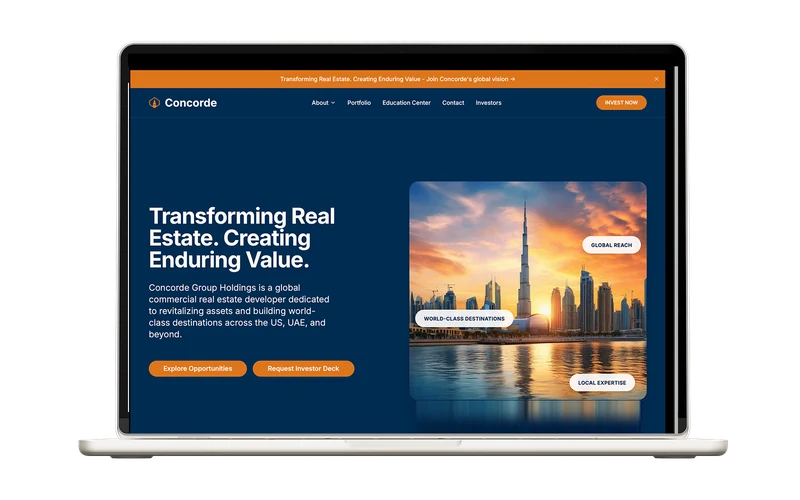
- Corporate site for an investor: Next.js, multilingual, custom design. From €1,500, 4 weeks. Details in the Concorde Group case study.
- Business website for a local company: WordPress, 7 pages, local SEO. From €500, 2 weeks.
Next step
The fastest way to find out what your site would cost: try our website cost calculator (2 minutes, instant ballpark) or see the full pricing by project type. For an exact quote, fill in the form: pick a project type and rough budget, describe the idea in a few sentences, and we reply with a concrete estimate within 24 hours. No obligation.
Frequently asked questions.
How much does a website cost to run per year?
Hosting and a domain run from about €70 a year, and our technical maintenance plans start at €50 a month, with a clear scope and no hidden costs. For smaller sites an annual arrangement is possible.
Can I pay for a website in instalments?
Yes, we normally split payment into a part on agreement and a part on delivery, and for larger projects we agree a schedule by phase.
Why are some offers drastically cheaper?
Usually because they exclude SEO, speed optimisation, mobile polish or post-launch support. Such a site looks finished, but brings neither visitors nor inquiries.
Ready for a concrete quote?
Fill in the form: tell us the project type and rough budget, and we reply with a realistic estimate within 24h.
Free estimate · No obligation · We deliver on the agreed deadline